Recombinant Human Tripartite motif-containing protein 5 (TRIM5)
Shipping Cost Note
Each Recombinant Protein price includes shipping cost to Canada and import fees. Please ask for a discounted quote if ordering multiple Cusabio products.
Delivery Time Note
This product is usually imported from the manufacturer after order placement. Please expect longer delivery times of 7-14 days.
Catalog No.
CSB-EP874861HU
Product Name
Recombinant Human Tripartite motif-containing protein 5 (TRIM5)
In Stock
Yes
Activity
Not Tested
Research Area
Cell Biology
Uniprot ID
Q9C035
Gene Names
TRIM5
Alternative Names
RING finger protein 88
Organism
Homo sapiens (Human)
Source
E.coli
Expressed Region
1-493aa
Protein Length
Full Length
Tag Info
N-terminal 6XHis-B2M-tagged
Target Protein Sequence
MASGILVNVKEEVTCPICLELLTQPLSLDCGHSFCQACLTANHKKSMLDKGESSCPVCRISYQPENIRPNRHVANIVEKLREVKLSPEGQKVDHCARHGEKLLLFCQEDGKVICWLCERSQEHRGHHTFLTEEVAREYQVKLQAALEMLRQKQQEAEELEADIREEKASWKTQIQYDKTNVLADFEQLRDILDWEESNELQNLEKEEEDILKSLTNSETEMVQQTQSLRELISDLEHRLQGSVMELLQGVDGVIKRTENVTLKKPETFPKNQRRVFRAPDLKGMLEVFRELTDVRRYWVDVTVAPNNISCAVISEDKRQVSSPKPQIIYGARGTRYQTFVNFNYCTGILGSQSITSGKHYWEVDVSKKTAWILGVCAGFQPDAMCNIEKNENYQPKYGYWVIGLEEGVKCSAFQDSSFHTPSVPFIVPLSVIICPDRVGVFLDYEACTVSFFNITNHGFLIYKFSHCSFSQPVFPYLNPRKCGVPMTLCSPSS
MW
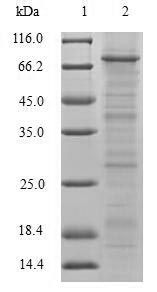
70.3 kDa
Purity
Greater than 90% as determined by SDS-PAGE.
Endotoxin
Not Tested.
Form
Liquid or Lyophilized powder
Buffer
If the delivery form is liquid, the default storage buffer is Tris/PBS-based buffer, 5%-50% glycerol. If the delivery form is lyophilized powder, the buffer before lyophilization is Tris/PBS-based buffer, 6% Trehalose, pH 8.0.
Resonstitution
We recommend that this vial be briefly centrifuged prior to opening to bring the contents to the bottom. Please reconstitute protein in deionized sterile water to a concentration of 0.1-1.0 mg/mL.We recommend to add 5-50% of glycerol (final concentration) and aliquot for long-term storage at -20℃/-80℃. Our default final concentration of glycerol is 50%. Customers could use it as reference.
Storage
The shelf life is related to many factors, storage state, buffer ingredients, storage temperature and the stability of the protein itself. Generally, the shelf life of liquid form is 6 months at -20℃/-80℃. The shelf life of lyophilized form is 12 months at -20℃/-80℃.
Notes
Repeated freezing and thawing is not recommended. Store working aliquots at 4℃ for up to one week.
Relevances
Capsid-specific restriction factor that prevents infection from non-host-adapted retroviruses. Blocks viral replication early in the life cycle, after viral entry but before reverse transcription. In addition to acting as a capsid-specific restriction factor, also acts as a pattern recognition receptor that activates innate immune signaling in response to the retroviral capsid lattice. Binding to the viral capsid triggers its E3 ubiquitin ligase activity, and in concert with the heterodimeric ubiquitin conjugating enzyme complex UBE2V1-UBE2N (also known as UBC13-UEV1A complex) generates 'Lys-63'-linked polyubiquitin chains, which in turn are catalysts in the autophosphorylation of the MAP3K7/TAK1 complex (includes TAK1, TAB2, and TAB3). Activation of the MAP3K7/TAK1 complex by autophosphorylation results in the induction and expression of NF-kappa-B and MAPK-responsive inflammatory genes, thereby leading to an innate immune response in the infected cell. Restricts infection by N-tropic murine leukemia virus (N-MLV), equine infectious anemia virus (EIAV), simian immunodeficiency virus of macaques (SIVmac), feline immunodeficiency virus (FIV), and bovine immunodeficiency virus (BIV) (PubMed:17156811). Plays a role in regulating autophagy through activation of autophagy regulator BECN1 by causing its dissociation from its inhibitors BCL2 and TAB2 (PubMed:25127057). Also plays a role in autophagy by acting as a selective autophagy receptor which recognizes and targets HIV-1 capsid protein p24 for autophagic destruction
References
"High-frequency persistence of an impaired allele of the retroviral defense gene TRIM5alpha in humans."Sawyer S.L., Wu L.I., Akey J.M., Emerman M., Malik H.S.Curr. Biol. 16:95-100(2006)
Function
Capsid-specific restriction factor that prevents infection from non-host-adapted retroviruses. Blocks viral replication early in the life cycle, after viral entry but before reverse transcription. In addition to acting as a capsid-specific restriction factor, also acts as a pattern recognition receptor that activates innate immune signaling in response to the retroviral capsid lattice. Binding to the viral capsid triggers its E3 ubiquitin ligase activity, and in concert with the heterodimeric ubiquitin conjugating enzyme complex UBE2V1-UBE2N (also known as UBC13-UEV1A complex) generates 'Lys-63'-linked polyubiquitin chains, which in turn are catalysts in the autophosphorylation of the MAP3K7/TAK1 complex (includes TAK1, TAB2, and TAB3). Activation of the MAP3K7/TAK1 complex by autophosphorylation results in the induction and expression of NF-kappa-B and MAPK-responsive inflammatory genes, thereby leading to an innate immune response in the infected cell. Restricts infection by N-tropic murine leukemia virus (N-MLV), equine infectious anemia virus (EIAV), simian immunodeficiency virus of macaques (SIVmac), feline immunodeficiency virus (FIV), and bovine immunodeficiency virus (BIV)