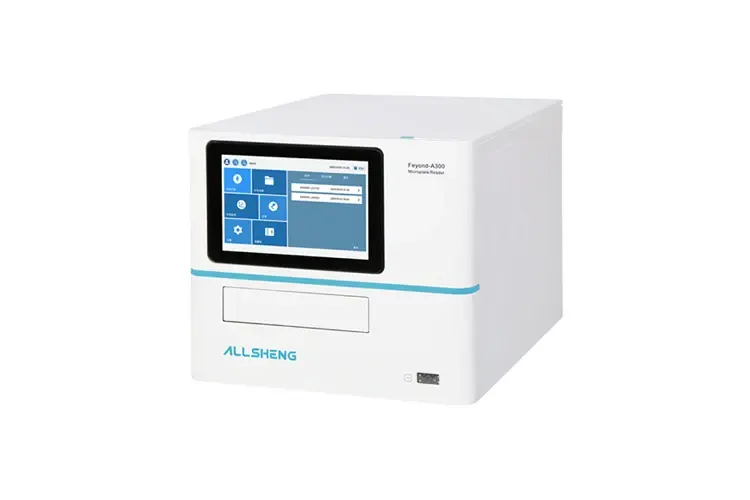
Feyond-A500 Multi-Mode Microplate Reader, ABS / FL / LUM / TRF / FP
The most complete reader in the Feyond-A series: absorbance, fluorescence, luminescence, time-resolved fluorescence and fluorescence polarization in one instrument, for labs running binding, enzyme and immunoassay work. Sold in Canada by Luna Nanotech of Markham, Ontario, with prices in Canadian dollars. Contact us with questions or for a quote.
The Feyond-A500 is the top model of the Feyond-A series, a five-mode microplate reader that adds fluorescence polarization (FP) to absorbance, fluorescence, luminescence and time-resolved fluorescence. It covers nearly every plate-based detection method on one instrument, including binding, enzyme and immunoassay work in drug discovery and life science research.
- Five detection modes: absorbance (ABS), fluorescence (FL), luminescence (LUM), time-resolved fluorescence (TRF) and fluorescence polarization (FP).
- Fluorescence polarization: an optimized filter design with detection to 5 mP for binding and enzyme assays.
- Sensitive TRF: detection limit as low as 0.02 pM under optimized conditions.
- Full spectral scanning: any wavelength from 200 to 1000 nm using a monochromator.
- Many plate formats: 6 to 384-well plates, PCR plates, and optional u-Nano ultra-micro plates.
- Incubation and shaking: up to 45 °C, with linear, circular and double-circular shaking.
- Upgradable: optional dual automatic injector and easy-change modular filters.
Catalogue number AS-19070-00.
Technical Specifications
- Model: Feyond-A500 (catalogue no. AS-19070-00), multi-mode: ABS, FL, LUM, TRF, FP
- Plates: 6, 12, 24, 48, 96 and 384-well; 96/384 PCR plates; u-Nano 16/96 ultra-micro plates
- Absorbance: xenon lamp; monochromator 200-1000 nm in 1 nm steps; wavelength accuracy 2 nm, repeatability 0.2 nm, bandwidth under 2.5 nm; range 0-4 OD, resolution 0.0001 OD; accuracy ±(1.0% + 0.003 OD) up to 2.0 OD; linearity R² ≥ 0.999 (0-3 OD); stray light 0.1% at 220 nm; 96-well plate read in under 15 s (fast mode)
- Fluorescence: top reading; xenon lamp; PMT detector; excitation 200-1000 nm, emission 270-850 nm; standard filters EX485/EM530, EX523/EM564, EX624/EM692 (others available); detection limit 1 pM; linear dynamic range 6 logs or more
- Luminescence: PMT detector; detection limit 15 amol/well or better (96-well white plate, flash ATP); crosstalk 0.005% or lower; 200-850 nm; linear dynamic range 6 logs or more
- Time-resolved fluorescence (TRF): filter EX365/EM612; detection limit 0.02 pM (optimized conditions)
- Fluorescence polarization (FP): filter EX485/EM530; detection limit SD 5 mP or better (sodium fluorescein)
- Read types: endpoint, kinetics, spectral scanning, well scanning (up to 900 points per well)
- Shaking: linear, circular, double circular; speed and strength adjustable
- Incubation: room temperature + 4 °C up to 45 °C; ±0.5 °C at 37 °C
- Display: 10-inch capacitive touch screen; 10 GB data storage
- Software: ReaderIt-II PC analysis software (Windows 10 and above, 64-bit); test reports can be uploaded to a PC server by FTP
- Ports: USB A x2, USB B x1, Ethernet x1, RS232 (for injector)
- Optional automatic injector: 1 or 2 channels, 5-1000 µL in 1 µL steps, 125-500 µL/s, accuracy ±1 µL (5-50 µL) or ±2% (51-1000 µL), 25 mL waste collection
- Power: AC 100-240 V, 50-60 Hz
- Dimensions (W x D x H): 420 x 550 x 386 mm
- Weight: 33 kg
Frequently Asked Questions
What is fluorescence polarization used for?
FP measures molecular binding and enzyme activity in solution. On the Feyond-A500 it has a detection limit of SD 5 mP or better, tested with sodium fluorescein.
How sensitive is the time-resolved fluorescence mode?
The TRF detection limit is 0.02 pM under optimized conditions (filter EX365/EM612).
How does the A500 compare with the A300 and A400?
The A300 covers absorbance, fluorescence and luminescence. The A400 adds TRF. The A500 adds FP on top of the A400's modes.
Does it have incubation and shaking?
Yes. Incubation runs up to 45 °C (±0.5 °C at 37 °C), with linear, circular and double-circular shaking.